Showing posts with label Storybook Week. Show all posts

Tuesday, August 30, 2011

How to Use Storybook Weeks


One way to use Storybook Weeks is to schedule about a half hour each weekday for learning activities and do one of the Storybook Week activities each day. There are generally five activities in each Storybook Week, including the Read-Aloud activity of reading the book together.

Each week is designed to include a variety of activities for different skill sets or academic subjects: gross motor skills, fine motor skills, language arts, social studies, math, science, fine arts, sensory activities such as cooking or working with weights or textures, and outdoor learning.

Monday could be spent reading the storybook. You may also want to watch the storybook video, or ask questions about the book and discuss it. Sometimes children may want to read it over and over again.

Tuesday could be spent on the next activity. If there is ever a time or an activity when a child doesn't want to do it, no problem. You can try it again the next day, or Saturday, or skip it entirely. Just like blind dates, sometimes a child and a learning activity do not have chemistry together.

Wednesday could be spent on the next activity. If the weather is bad for an outdoor activity, switch the order of the activities. These activities can be adapted and used as loosely as you want. Maybe one day of the week is much better for cooking, so you can save any cooking activities for that day.

And so on. They can be used all at once or on random days. Whatever fits your life.

If you are using the Five in a Row curriculum, there are differences such as the assigning of each of five subject areas to a day of the week (social studies, language arts, art, applied math, and science). Storybook Weeks are more along the lines of the flexible, book-based play activities supplied by Before Five in a Row.

 If you are using the Charlotte Mason philosophy, some of the Storybook Weeks books overlap with the Early Years Read-Alouds list at simplycharlottemason.com. The benefits of reading good literature (e.g., long-lasting and successful story books) to children are promoted in the Charlotte Mason method and believed in here at Afterschool Homeschool.

Deb at LivingMontessoriNow has a list of Montessori-Inspired unit studies that can be used in conjunction with Storybook Weeks. For example, this Montessori-Inspired Dinosaur Unit could be used during the How Do Dinosaurs Say Goodnight? Storybook Week.

The way that helps our family the most is to hold pretty fast to a scheduled time for "learning activities" each day. Then we hold very loosely to the planned activities by changing, rushing, extending, skipping, or repeating them as dictated by the children's interest. Sometimes "learning activities time" turns into home haircut time or time to sit and listen to the children tell me something. Or free play when they are simply obsessed with a certain type of play at the time.

Monday, August 22, 2011

Storybook Week 12: The Snowy Day

The Snowy Day, by Ezra Jack Keats, is one of those books that resonates with my children. My toddler never gets tired of it.


It is challenging to write about The Snowy Day at the end of a southern summer when the high temperature today is 106 degrees Fahrenheit, but I think the current weather makes the story even more fascinating to children who have not seen snow in at least a few months. (I bet some people in the United States have seen snow this summer, but let's assume they're in the minority.)

If you are reading this post in the winter in a snowy region, this particular Storybook Week will be almost too easy. :)

1. Read The Snowy Day
Read-Aloud/Language Arts

You can choose from many versions of the book - we have the board book that I found at Goodwill one year -


or watch the storybook video


or both.

2. "Snow had fallen during the night."
Story Interest/Fine Motor Skills

How cool would it be if your child woke to snowflakes on the window panes? You could go crazy and cut out paper snowflakes to cover all your windows, or just choose one window. Or, if you have a child who sleeps heavily, you could tiptoe in and cover their bedroom window with snowflakes.

For those who haven't made paper snowflakes before, there are simple instructions here at Enchanted Learning.

So, now that you have a snow-covered window, point out the snowflakes to your children when they wake. Southern families may need to have a conversation about what snow is and what real snow feels like.

For advanced toddlers, preschoolers, and up:

Ask if they want to make more snowflakes. Follow the same procedures to help children fold and cut their own snowflake decorations.

Or, let children use a hole-punch on white paper to create small, falling snowflakes. Instructions: Punch, punch, punch that paper! They're guaranteed to love this activity; just make sure it is done in a place that makes for easy clean-up of tiny paper pieces.

3. Footprints
Story Interest/Gross Motor Skills

If you have a place that is easy to sweep up and you are willing to deal with lots of fine-ground stuff on the floor, then this activity is for you. I might even recommend the back yard for this.

 Lay down a walkway of flour, cornmeal, or a similar substance. Show children how to walk with their toes pointing out to make the kind of footprints Peter makes in the story.

Let them make tracks.

Lay down some more flour to make a new, track-free surface. Make sure they are finished looking at their great tracks first. Then have them walk with their toes pointed in to make the second type of tracks Peter makes.

The third time around, have them drag their feet to make straight lines. Add a walking stick they can drag to make a third line.

Ah, sticks. They make any activity better. In the mind of a small boy.


4. Snowy Ice Cream
Cooking/Sensory Activity

This recipe is from Merry Musical Treasury Pooh Christmas Stories, a favorite of my son's.


You will need:

1 large package fruit flavored gelatin
1 can sweetened condensed milk
1 package frozen strawberries (or any frozen fruit)
1/2 gallon milk
shaved or crushed ice, about a half cup per serving - or snow!

Mix all the ingredients except the shaved or crushed ice. Pour the mixture until it fills a cup half full. Add shaved or crushed ice almost to the top, stir until it is thick and creamy, and enjoy.

If it is winter and you have (clean) snow available, you can use that instead of shaved or crushed ice.

5. Snowball Fight!
Story Interest/Sensory Activity/Gross Motor Skills

Crumple up paper. It's a satisfying yet harmless way for children to get out some energy or agrression through their hands. Aren't you glad you bought extra copy paper during the back-to-school sales? Oops, I didn't.

But any kind of paper, like leftover packing paper, newspaper, or wrapping paper works.

The rest of this activity is up to the discretion of you, the parent. Either you can all enjoy a mild "snowball" fight with your wadded-up balls of paper, or you can wisely redirect your children to trying to hit a target on the wall. (Just draw a big red-and-white target and tape it up.) Bulls-eye!


Monday, July 11, 2011

Storybook Week 10: Make Way for Ducklings


Make Way for Ducklings was written and illustrated by Robert McCloskey. This is one of the classics that is a delight to hold in your hands while looking at the wonderful illustrations.

1. Read the Story
Language Arts
 
Read the book Make Way for Ducklings, or watch the storybook video, or both. Take your time and enjoy this classic book.

Although, in my opinion, there is nothing that can replace a book, the storybook videos in Scholastic's Treasury of 100 Storybook Classics are well-done. What I like about them are the slow pace, the animation in the style of the original illustrations, and the use of the original text of the books. Each of these videos is more like the experience of a read-aloud than any video other I have seen.

2. Nesting
Story Interest/Dramatizing/Science

With your child, explore the house for just the right spot to make a nest. When your child has found the exact right spot, mark it with a pillow or anything else that comes to hand.

Now, together you must collect the materials for your nest. Younger children will need your suggestions of using pillows, blankets, etc., for next materials. Older children will most likely have plenty of their own ideas.

Make the nest, and sit on it, of course. If your child wants eggs to sit on and to hatch, crumpled and shaped paper works well. If you have miniature bird figures at home, they can even be inserted into the middle of an egg.

Optional: After doing the activity, watch a video of birds making a nest. Discuss the things you did to make your nest that were similar and different.

3. A Second Breakfast of Peanuts
Story Interest/Fine Motor Skills

All who are not allergic to nuts and who are old enough to eat them can have a "second breakfast" just like the Mallards'. Raisins could also be used instead of nuts.

Get out a jar of peanuts and pour them into a container with a wider opening. Give your child a  bowl for his or her peanuts, and a pair of tongs or tweezers. With the tongs or tweezers, your child should practice transferring peanuts to the snack bowl. Depending on the utensils and the child, this might be a challenging activity. A small measuring cup or spoon can be substituted for the tongs or tweezers.

4. Make Way for Ducklings Interactive Map Activity
Social Studies/Geography

Use this amazing interactive map to take the journey the Mallards did!

5. Police Officers to the Rescue
Social Studies/Dramatizing

Using rubber duckies and a road made of blocks, car tracks, or a road drawn on a piece of paper, have your ducks try to cross the road. A line of Matchbox cars or other vehicles waiting to the side heightens the sense of danger.

Have your child, the police officer, stop all traffic with a commanding hand so the ducks can safely cross. This police hat and badge printable would help your junior officer(s) a lot!

Thursday, July 7, 2011

How Do Dinosaurs...? Puzzle Activity

For anyone doing the How Do Dinosaurs Say Goodnight? Storybook Week (or anyone whose children love dinosaurs), this activity from Crafts~N~Things for Children is a spectacular, easy addition. I love it!

Because my children love both dinosaurs and puzzles, and because I have all the necessary materials (hurray!), we will be doing this activity posthaste.


Find the full How Do Dinosaurs Say Goodnight? Storybook Week here, at the link above, or in the Storybook Weeks sidebar.

Saturday, July 2, 2011

I Stink! Storybook Activity, Documented

We are doing the Read. Explore. Learn Summer Reading Challenge today. (See the badge to the right.) I'm so excited about it!
 

In Your Community
Social Studies/Story Interest/Arts and Crafts


This is part of Afterschool Homeschool's Storybook Week on I Stink! by Kate McMullan. (See my disclosure about affiliate links below.)


"Talk about your community: Do you see police officers in your community? Fire trucks? Where are the library, city hall, fire station, grocery stores, haircutting shops, and post office? Do you see garbage collectors in your neighborhood? What do they do? Where does your trash go?

Set up a play community using building blocks. Or, if you have them, use play sets. Here is one that we used for a while. And here is a great idea for building a Safety Town out of cardboard boxes, paper, glue, and markers or crayons. (The craft idea is at the end of part two of this great safety tips video. It is not step-by-step instructions, just a demonstration of what the children made. They use cardboard boxes of different sizes, glue white paper onto the surfaces, and allow the children to decorate them into whatever "safer buildings" they like.)"

We used our wooden blocks to make a town. It had a fire station, police presence, roads, and a garbage truck that was going around picking up "trash cans" (tiny Lego barrels work well if you can use them around your children without them being lost or swallowed).


The children liked this activity. What they really liked was reducing the town to this:

Then it could evolve into a castle (with their dad's help):

Which could then be joyfully reduced to this:


Afterschool Homeschool is now a participant in the Amazon Services LLC Associates Program, an affiliate advertising program designed to provide a means for sites to earn advertising fees by advertising and linking to amazon.com. Where I have noted that I do not receive compensation for reviewing or linking to an item, that is true and means that the relevant link is not an affiliate link. Thank you for visiting Afterschool Homeschool!

Monday, June 27, 2011

Storybook Week 9: I Stink!

I Stink! was written by Kate McMullan and illustrated by Jim McMullan. The first thing to do for Storybook Week 9 is to get hold of a copy of I Stink! from your local library, amazon.com, barnesandnoble.com, or favorite brick-and-mortar book store.


1. Read the Story
Language Arts

Read the storybook or watch the Weston Woods storybook video from Scholastic Treasury of 100 Storybook Classics. Or do both.

2. In Your Community
Social Studies/Story Interest/Arts and Crafts

Talk about your community: Do you see police officers in your community? Fire trucks? Where are the library, city hall, fire station, grocery stores, haircutting shops, and post office? Do you see garbage collectors in your neighborhood? What do they do? Where does your trash go?

Set up a play community using building blocks. Or, if you have them, use play sets. Here is one that we used for a while. And here is a great idea for building a Safety Town out of cardboard boxes, paper, glue, and markers or crayons. (The craft idea is at the end of part two of this great safety tips video. It is not step-by-step instructions, just a demonstration of what the children made. They use cardboard boxes of different sizes, glue white paper onto the surfaces, and allow the children to decorate them into whatever "safer buildings" they like.)

3. Parts of a Garbage Truck
Story Interest/Fine Motor Skills/Arts and Crafts/Language Arts

This eHow page describes types of garbage trucks and their parts. You and your child can learn vocabulary words like: cab, hopper, passenger cabin, compactor, packer blade, rear-loader, front-loader, hydraulic, and lift.

Here you can see pictures of actual trucks to apply your new vocabulary.

Here you can print off garbage truck pictures for coloring.

If you don't already have a garbage truck in your toy collection and your child is very interested, consider investing in a toy garbage truck with working parts (this one has removable trash bins and figures).

For an older child: This is also an investment, but you might consider buying the Melissa & Doug Mighty Builder Garbage Truck which requires a lot of assembly using a screwdriver. We have not used this product, but from reading the reviews, it seems like a big hit with young children. It needs assembly by an older person, so it might be a good fit for a family with both older and younger children. (I've included links in this post solely based on relevance; we have not tried these products and I don't receive any benefit from mentioning them.)

4. Your Own Alphabet Soup Recipe
Story Interest/Language Arts

In the story, the garbage truck gives his recipe for alphabet soup, made in the back of his truck. It includes apple cores, banana peels, and other trashy items. You and your child can think up your own alphabet soup recipe by going through the alphabet and finding words that start with each letter. It would be an added learning tool to use a chalkboard, dry-erase board, or Magna-doodle to write the words you come up with next to each letter. Your alphabet soup recipe-making could even extend across twenty-six days if you assign one letter to each day.

The very most ambitious among you might even come up with a food item for each letter and make that food with your child, although it would take some stamina to do all twenty-six letters this way!

 5. And Even More Garbage Truck Activities!
Arts and Crafts/Gross Motor Skills/Social Studies


This eHow page has additional fun and educational activities about garbage collection.


To see previous Storybook Weeks, click one of these links:

Storybook Week 1: Chicka Chicka 1, 2, 3: http://schooloutofschool.blogspot.com/2011/04/storybook-week-1-chicka-chicka-1-2-3.html

Storybook Week 2: Chicka Chicka Boom Boom: http://schooloutofschool.blogspot.com/2011/04/storybook-week-2-chicka-chicka-boom.html

Storybook Week 3: Chrysanthemum: http://schooloutofschool.blogspot.com/2011/04/storybook-week-3-chrysanthemum.html

Storybook Week 4: Click, Clack, Moo: Cows That Type: http://schooloutofschool.blogspot.com/2011/04/storybook-week-4-click-clack-moo-cows.html

Storybook Week 5: Curious George Rides a Bike: http://schooloutofschool.blogspot.com/2011/05/storybook-week-5-curious-george-rides.html

Storybook Week 6: Diary of a Spider: http://schooloutofschool.blogspot.com/2011/05/storybook-week-6-diary-of-spider.html

Storybook Week 7: Harold and the Purple Crayon: http://schooloutofschool.blogspot.com/2011/05/storybook-week-7-harold-and-purple.html

Storybook Week 8: How Do Dinosaurs Say Goodnight?: http://schooloutofschool.blogspot.com/2011/06/storybook-week-8-how-do-dinosaurs-say.html

Wednesday, June 15, 2011

Night-night, Dinosaurs

Two days ago, I posted a Storybook Week post for How Do Dinosaurs Say Goodnight? Here is a picture of the result of one of those activities at our home:

Sweet, aren't they?

Monday, June 13, 2011

Storybook Week 8: How Do Dinosaurs Say Goodnight?

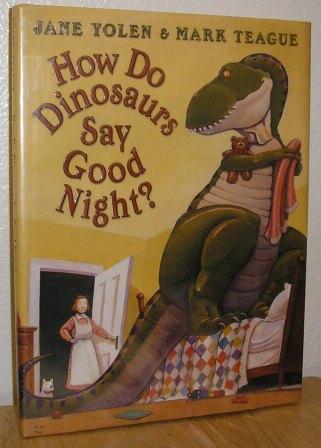
How Do Dinosaurs Say Goodnight?, one of a series of marvelous, fantastic, wonderful books starring dinosaurs, was written by Jane Yolen and illustrated by Mark Teague.

customer image from Amazon.com


1. Read Aloud
Language Arts

Read the story to your child and/or watch the storybook video.

2. Tuck in Dinosaurs
Story Interest/Pretend Play

Make a cozy box, container, or doll bed into a bed for some toy dinosaurs. Use dinosaurs you already have at home or print and cut out pictures of dinosaurs. Don't forget pillows, blankets, and teddy bears! Let your child soothe dinosaurs who are stomping, roaring, or crying. Show your child how to read a story and give hugs and kisses and tell the dinosaurs good night.

3. Dinosaur Roar!
Outdoor Activity/Dramatizing

This is a good opportunity to teach outdoor voice versus indoor voice. Tell your child dinosaurs are allowed to whisper inside the house. Practice whispering. Then say that they are allowed to roar when they are outside!

Go outside and practice roaring at the top of your lungs. Try a Velociraptor roar, then a Tyrannosaurus roar, then a Brachiosaurus roar. Do they sound different?

4. No Jumping on the Bed
Gross Motor Activity/Dramatizing

Lay a rug or mat out on the floor. Put pillows at the head. Pretend to be naughty dinosaurs jumping on the bed. Jump up and down on the mat. (If you are putting the rug or mat on a smooth floor, be sure it won't slide and cause accidents.)

When you are done being naughty dinosaurs, lay down and pretend to sleep. Older children might like to snore or learn to pretend-snore.

5. Teddy Bear Toss
Gross Motor Activity

Take a laundry or other type of basket and place it somewhere in front of a couch that your children can sit on. This game is fun with more than one person, if possible. Place a pile of teddy bears (and other stuffed animals, if you like) next to your children. Have them take turns tossing a bear into the basket. Encourage them to get the bears as close to the basket as possible, if not inside it.

Caution: If you are in the middle of teaching a baby or young toddler not to throw things in the house, you may want to adapt this activity. Place the pile of bears on the floor next to the basket and announce that it's clean-up time! The bears all want to go inside! Then take turns placing bears nicely into the basket. When you're finished, the basket can be dumped out and you can start again.

This activity is great for babies who can sit up and throw (or drop) things. It is also great for toddlers, preschoolers, and young siblings playing together.

Additional Ideas:

I just found this post on a Dinosaur Theme Week at one of my favorite blogs, Children's Learning Activities. Dig in to these ideas!

Also see my post highlighting the Dinosaur Popsicle-Stick Puzzle activity from Crafts~N~Things for Children for a great activity that is easy to do.

Tuesday, May 24, 2011

Storybook Week 7: Harold and the Purple Crayon

This week the storybook is Harold and the Purple Crayon, written and illustrated by Crockett Johnson.


1. Read the Book
Language Arts/Story Interest


Together with your child, read the book or watch the storybook video.


2. Make a Safety Town
Arts and Crafts/Safety/Dramatizing/Pretend Play

In Harold and the Purple Crayon, Harold decides he needs a moon, so he draws one. He needs a path, so he draws one to walk down. Through his adventure, he keeps hold on his purple crayon so that he can create what he needs, whether it be a shortcut across a field or a whole city. This is a powerful concept for children. The idea that they can create the world they want to play in through their imaginations is a breathtaking one.

I like this Safer Strangers, Safer Buildings video from Child's Eye Media to combine safety information for young children with a way to play pretend with these new ideas. Look at the end of Part 2 to see the safe buildings the children make to create a safe town. It looks like they are making the buildings out of small cardboard boxes about the size of instant oatmeal boxes. The boxes are covered with white paper so that the children can draw any embellishments or signs they like on their buildings. Adding people and vehicles to the town would of course make it even more fun.

3. Purple Paper Night Sky
Arts and Crafts

Your child may want to draw with a purple crayon after reading this book. That would be fantastic; let your child do what he or she likes with a purple crayon and paper. Be prepared for a nice story about what is being drawn.


A different activity for children who are not interested in a purple crayon is to use purple construction paper and white chalk to make a night sky. The texture of chalk on construction paper can be a learning experience in itself.

For a baby or toddler: Allow your baby or toddler to use chalk on construction paper if baby is old enough to safely hold and use chalk. Your toddler may be quite fascinated with making white marks on a colored paper instead of the other way around.

For a preschooler: Ask your child to draw stars and a moon on your purple paper to make a night sky. You might even add to the picture yourself.


For an older child:
Combine learning about constellations with drawing some on the paper. If you have not already learned together about constellations, look up some pictures of constellations in the sky. For this arts and crafts activity, have your child make up his or her own constellations and name them.


4. Sailboats
Story Interest/Science

Harold draws a sailboat and sails across water. How does a sailboat work? What makes it go?

Explain that a sailboat needs its sails to be up so that wind can blow the sails and push the boat.

For a toddler or preschooler: Find two plastic bath toy boats, one with a sail and one without. Draw a bath, put your child in, and do an experiment. First put in the boat without a sail. Blow on it. Allow your child to blow on it too. The breath might move it a little bit but likely won't push it forward very far. Now take that boat out and put in the boat with the sail. Blow on the sails. This boat should move forward much more easily because there is wind in its sails.

For an older child: Have your child build a sailboat. Here is a link to a 5th Grade Sail Boat Project.


5. Finding Your Room
Geography/Story Interest/Physical Activity

Start in your child's bedroom. Now lead him or her out to another room. Instruct your child to go back to the bedroom. Ask how they found it. Go to another room. Tell your child to get back to the bedroom as quickly as possible. Try this from one other room.

For a toddler: Do the above activity, emphasizing which room is your toddler's room. Have fun with it! If your toddler needs an extra challenge, try it with all the lights out and a flashlight.

For a preschooler: Do the above activity, asking your child which direction they are going as they navigate to their room. Do the flashlight variation because a preschooler will be delighted with it!

For an older child: Have your child first walk back to the room, then sit down somewhere and draw a map to show the way they walked. This map can be as simple or as elaborate as necessary. Some preschoolers can do this activity.


Note: Anytime you or your child gets excessively frustrated with an activity, take a deep breath and remember the purpose of the activity. Some of your purposes may be: To teach, to learn, to have fun, to spend quality time together, and to evaluate your child's abilities. It is usually better to avoid an outburst of frustration with each other than to complete an activity. Sometimes just taking that breath, looking each other in the eyes, and thinking for a moment about the real issue bothering one (or more) of you is extremely valuable.

Monday, May 16, 2011

Storybook Week 6: Diary of a Spider

This week the storybook is Diary of a Spider, written by Doreen Cronin and illustrated by Harry Bliss.

1. Read the Book
Language Arts/Story Interest


Together with your child, read the book or watch the storybook video.

2. Start a Personal Diary
Story Interest/Arts and Crafts/Fine Motor Skills/Language Arts

Start with a blank composition book or notebook and pictures that will be interesting and relevant to your child, like pictures of him- or herself, family members, animals, and special interests. Tape or glue a picture of your child to the cover. (Or let your child do this.)

For your younger child, write a heading on top of each page. Categories that work well are Family, Animals, Numbers, Letters, Dinosaurs, Colors, Shapes, and character pages for your child's favorite book and TV characters.

For a baby or toddler: Paste pictures and photographs of each category under the appropriate heading. Allow your toddler to color on pages.

For a preschooler: Paste one or two pictures and photographs in each category, leaving plenty of room on each page. Draw a few writing guidelines at the bottom of the page so your child can write something about the page. Ask your child to draw pictures from the category on each page and then write something about it at the bottom. You may need to write for them, but do ask what they want to say about the page.

For an older child: If necessary, show your child how diary entries can start with the date that they are written. Have them write what they want about their day and allow them to use pictures and photographs to illustrate.

Alternative 1: 
If your child is into photography, allow him or her to make a photojournal on a topic of his or her choice. If it would be easier, use a blog or other online format for your child to post digital pictures. Make sure it is a secure site so it can be kept private if appropriate and so that you and your child can monitor what information is available to strangers.

Alternative 2:
Organized Christmas has a great idea for a frugal gift that can be used in this activity: a Journal Jar. The gift idea includes a journal and a jar of journal prompts to get someone writing. I've included the link to the Child's Journal Jar but there is also one for adults.

3. Spiders vs. Insects
Science/Arts and Crafts

Learn about arachnids. You may have a favorite science book or encyclopedia at home that describes arachnids, or you can use this great fact page from BioKIDS. Talk about the differences between arachnids and insects.

Next, do a fun spider craft together. This is a good one posted at Children's Learning Activities.

4. Babysteps Flash Cards
Story Interest/Organization

Together, choose something your child wants to learn to do. Help him or her break it down into three steps to practice. Have an older child write down each step on a separate index card. For younger children, write it for them. A picture of each step would be helpful and interesting as well.

Show your child how to practice each step, one at a time. Let him or her keep the flash cards to practice at other times.

5. Differences
Appreciation of Diversity/Emotional Awareness

Have your child choose one of his or her friends to talk about. Talk about the things your child likes about the friend. Ask if there are any things about the friend that are different from your child. You can help with ideas if your child can't think of any (hair color, skin color, eye color, length of hair, where the child lives, family, what the child likes to do, the child's favorite color, the child's favorite TV show, etc.) List two or three of these differences that your child likes about his or her friend.

Now think of someone else who is different from your child. This could be another child, a neighbor, a classmate, or a character from a book, game, or show. Think of their differences. Again list two or three differences that your child likes or thinks is interesting.

You may want to ask a few follow-up questions, but this topic probably doesn't need to be belabored. Some examples are:

"Can people who are different be friends?"
"Do you like to learn new and different things?"
"Do you like to meet new and different people?"
"How does it feel to notice something different about another person?"
"How does it feel to be different from someone else?"

Tuesday, April 12, 2011

Storybook Week 2: Chicka Chicka Boom Boom

Chicka Chicka Boom Boom was written by Bill Martin, Jr., and John Archambault and was illustrated by Lois Ehlert. This is another classic children's book, one that many people call the best storybook for children under six. It should be readily available at the library, on Amazon.com or Barnesandnoble.com, or in brick and mortar book shops. We have the DVD as part of the Scholastic Treasury of 100 Storybook Classics. (I do not get any benefit from recommending these sites, books, or DVDs - they are simply things that I have used and liked.)

1. Coconut Tree Craft
Arts and Crafts/Story Interest


Read the book or watch the DVD together. Use this simple Coconut Tree Craft from DLTK's Growing Together website.

Adjust for toddlers and younger preschoolers by cutting and/or pasting for them.


For older children or those who have an interest, look up coconut tree facts and pictures to learn more. Show them on the map where coconut trees mostly grow. Here at 4to40.com are some facts about coconuts.


2.  Letters Come Tumbling Down
Story Interest

For this activity, you will need a foam, magnet, or other set of letters of the alphabet. Use the coconut tree craft you made in Activity 1. With your child, play out the story with these letters. Have A ask B to go up the tree. March or skip the letters up the tree and set them in the branches or leaves or on the top of the tree. When they have all gotten up the tree, make them tumble down!

For a toddler: 

Make a big deal of the tumbling down part. Shake the paper tree until the letters fall down. Pick up the letters again and repeat the activity. This will be even more fun for a toddler if you get a box or container and tape or glue the picture of the tree inside the container. It will become another way for toddlers to play the clean-up-dump-out-clean-up-dump-out game. (I know my toddler loves this game!)

3. Be a Letter
Dramatizing/Sensory Activity

Use your own and your child's bodies to form letters of the alphabet on the floor. Your child may like to stand up and form the shape of a letter as best she can on her own in order to act out part of the story. It would be even better to have someone on hand to take pictures of this activity.

For a toddler:

Try forming the letter A by standing with legs apart and arms overhead with palms together. Say, "A! I'm the letter A!" See if your toddler can imitate you. Take pictures!

4.  Who Wrote the Book?
Language Arts

For this activity, you will need the book physically on hand. You may also want to have other books written by Bill Martin, Jr., or illustrated by Lois Ehlert to look at. There are many books by these two at the library.

For a preschooler or kindergartner: Open to the title page and tell your child that this is called the title page, and that every book has one. Show them what information is on the title page.

Tell them that the person who wrote the words in the book is the author. Give them the author's name. If you have other Bill Martin, Jr., books, show those to your child and point out his name on each of the title pages.

Explain how the person who drew (or created) the pictures in the book is called the illustrator. If you have other Lois Ehlert books on hand, show them to your child and point out her name on the title pages.

Ask, "Who is the author of this book?", pointing to Chicka Chicka Boom Boom.

Ask, "Who illustrated this book?"

For a toddler or baby: Read and show books by Bill Martin, Jr., or illustrated by Lois Ehlert. Continue as long as it holds your baby's or toddler's interest. Keep the books near to look at them and read from them throughout the next week or two.

5. Cook a Coconut
Cooking/Sensory Activity

CDKitchen has an Easiest Coconut Pie recipe that children can help with. Older children can help with all of the recipe; younger children can pour or toss in the shredded coconut. The Homemade Baby Food website says that coconuts are not a common allergenic food and has more information on babies and coconut. According to that site, coconuts are not related to peanut or tree nut allergies but are related to latex allergies. Please use your pediatrician's guidance to determine what your baby can safely eat.

If you can find one and have the money in your grocery budget, it would be very helpful to buy a real coconut so your child can handle it, look inside (once an adult cuts it for them), and compare the shredded coconut to the whole coconut. Chowhound has some readers' ideas for using a whole coconut.

Monday, April 4, 2011

Storybook Week 1: Chicka Chicka 1, 2, 3

Chicka Chicka 1, 2, 3 was written by Bill Martin Jr., and Michael Sampson. It was illustrated by Lois Ehlert. The very first step in the Chicka Chicka 1, 2, 3 Storybook Week is to get a copy of the book and/or the video (Weston Woods Scholastic, 2005). The book is readily available in libraries, on Amazon.com, and in bookstores. The DVD is available on Amazon as well, and as part of the Scholastic Treasury of 100 Storybook Classics.

1. The Numbers of Chicka Chicka 1, 2, 3
Read-Aloud/Story Interest


Read the book or watch the Weston Woods Scholastic story video. For the following activity, use a pack of number flashcards (about $2-$3 at a convenience store like Walgreens) or make them yourself.

To make number cards, simply type the numbers in a large font size in a word processing document, leaving spaces between each number. You may want to use different colors for each number or do every 10th number in the same color, or any other idea you think would be fun. Print on card stock. Cut the numbers out in squares.

Take from the pack the numbers 1-20, 30, 40, 50, 60, 70, 80, 90, 99, and 100. Ask your child to put these numbers in the order that they appear in the story.

For a baby or toddler: Show the flashcards, one by one, and say the number out loud. 1-10 is probably plenty for this age group. For an older baby or toddler, hand the card to them so they can look at it more closely. Better yet, use the foam numbers you can find in grocery stores, Amazon.com, or the baby aisle of Target.

For an older child: After doing the above activity, have your child reverse the order and count backwards down to 1.

2. Counting by Tens
Sensory learning/Math concepts

Use this free ebook by Jim Erskine for Candy Math ideas to learn counting by tens with candy or colored cereals. It is part of the first activity in the ebook, titled Skip Counting.

3. Bumblebees!
Science concepts/Arts and crafts

Go on a bumblebee hunt outside. If the season or area is not a good one for bumblebees, read together a book or website about bumblebees, like this one. It is always fun to bring a magnifying glass or binoculars, if your preschooler has either of these.

For toddlers: Point to as many pictures of bumblebees as you can find and make the "bzzz, bzzz" sound. Together, pretend to be bumblebees and go buzzing around the house.

For babies: Make a bumblebee puppet and have it buzz over the pages of the book. If baby has older siblings, they could be in charge of making the puppet. This is a fun puppet that would be a good project for a preschooler. Be sure the baby is never left alone with it because the antennae, tape, and/or bag could be unsafe for babies. If you are a knitter, this is a cute bee knitting pattern that you could make with or without the cord.

4. Number Four
Fine motor skills/Number recognition

Ask your child to write a large block number 4. Or write it yourself or draw tracing guidelines for younger children. Have your child color it, then cut out the outline of the number. A child who needs an easier cutting activity can cut out the number in a square if you draw the guidelines.

5. What Happened?
Narration/Thinking about the story

Ask your child:
"Who was left out of the tree?"
"Why was zero crying?"
"What happened at the end?"

If your child needs more writing practice have him or her write out the answers. If your child is younger or does not yet write, write down the answers as he or she speaks to show the attention you are paying to their answers.
Related Posts Plugin for WordPress, Blogger...