Showing posts with label dramatizing. Show all posts

Monday, July 25, 2011

Storybook Week 11: Pete's A Pizza

This week's storybook classic is Pete's A Pizza, written and illustrated by William Steig. In this book, Pete is in a bad mood. Luckily, his dad is there to help.

Image courtesy of clker.com


1. Read the Story
Language Arts
 
Read the book Pete's A Pizza, or watch the storybook video, or both.

2. Cooking Your Child
Story Interest/Dramatizing/Gross Motor Skills

Did that heading catch your attention? The second activity related to Pete's A Pizza is to make a pizza out of your child, of course. Follow along with the book or make up your own process.

In the book, Pete's dad makes him into a pizza by kneading the dough (rolling Pete), spreading it (stretching Pete's arms), whirling and twirling (throwing Pete up in the air), applying oil (water), adding flour (you just want to pretend here - baby powder can be very dangerous for young children to inhale), and topping with tomatoes (checkers, for example).

This is a great activity for children who naturally need more large body movements. It might calm down some children who need lots of physical action. Research shows that it is good for children to have "wrestling" or other physical goof-off time with their parents, especially their fathers.

Babies gain so much - even in brain development - from touch, so this particular activity would be good for babies, too.

3. Drawing Moods
Arts and Crafts/Fine Motor Skills/Music


You and your child each get a piece of paper and drawing utensils. Both of you draw a picture of a sad child. Then a grumpy child. Then a giggling child. If you like, you can play different pieces of music that have different moods (lively classical, soothing lullaby, rock 'n roll, etc.) Try to draw the music or the mood that you hear or feel.

4. and 5. Cooking Your Pizza
Cooking/Fine Motor Skills/Pretend Play

You and your child might catch yourselves feeling hungry for pizza tonight after all this pizza-type activity.

First, set up a grocery store with any play kitchen materials you have. If you don't have kitchen and food toys, see how many empty boxes and containers you can raid from your real kitchen to set up the pretend grocery store. A plastic grocery cart makes this enjoyable, but any bag or basket will do.

Set your child on a hunt for ingredients you will need to make pizza. You can get into the grocery shopping trip as much as you want to, incorporating cash register and money and making change, or just let your child play a bit before making the real dinner.

Second, make the real pizza with real ingredients. Here is a super easy and delicious recipe I often use:

Ingredients:

whole wheat pita bread (2 packs)
pesto sauce
tomato paste (1 or 2 small cans)
sliced vegetables, any you like
shredded cheese, whatever type you like or have on hand

Instructions:

Spread pesto sauce on each pita circle, then tomato paste. Add sliced onions, peppers, black olives, meat, mushrooms, or whatever you like on your pizzas. Top with shredded cheese (cheddar is delicious; mozzarella gives it a lighter taste). Bake in a 375 degree oven for about 10 minutes. Take out when the cheese is melted. Allow them to cool and eat them as is or cut into wedges or strips for children.

Since this recipe is all about spreading and topping, children can help quite a bit.

Monday, July 11, 2011

Storybook Week 10: Make Way for Ducklings


Make Way for Ducklings was written and illustrated by Robert McCloskey. This is one of the classics that is a delight to hold in your hands while looking at the wonderful illustrations.

1. Read the Story
Language Arts
 
Read the book Make Way for Ducklings, or watch the storybook video, or both. Take your time and enjoy this classic book.

Although, in my opinion, there is nothing that can replace a book, the storybook videos in Scholastic's Treasury of 100 Storybook Classics are well-done. What I like about them are the slow pace, the animation in the style of the original illustrations, and the use of the original text of the books. Each of these videos is more like the experience of a read-aloud than any video other I have seen.

2. Nesting
Story Interest/Dramatizing/Science

With your child, explore the house for just the right spot to make a nest. When your child has found the exact right spot, mark it with a pillow or anything else that comes to hand.

Now, together you must collect the materials for your nest. Younger children will need your suggestions of using pillows, blankets, etc., for next materials. Older children will most likely have plenty of their own ideas.

Make the nest, and sit on it, of course. If your child wants eggs to sit on and to hatch, crumpled and shaped paper works well. If you have miniature bird figures at home, they can even be inserted into the middle of an egg.

Optional: After doing the activity, watch a video of birds making a nest. Discuss the things you did to make your nest that were similar and different.

3. A Second Breakfast of Peanuts
Story Interest/Fine Motor Skills

All who are not allergic to nuts and who are old enough to eat them can have a "second breakfast" just like the Mallards'. Raisins could also be used instead of nuts.

Get out a jar of peanuts and pour them into a container with a wider opening. Give your child a  bowl for his or her peanuts, and a pair of tongs or tweezers. With the tongs or tweezers, your child should practice transferring peanuts to the snack bowl. Depending on the utensils and the child, this might be a challenging activity. A small measuring cup or spoon can be substituted for the tongs or tweezers.

4. Make Way for Ducklings Interactive Map Activity
Social Studies/Geography

Use this amazing interactive map to take the journey the Mallards did!

5. Police Officers to the Rescue
Social Studies/Dramatizing

Using rubber duckies and a road made of blocks, car tracks, or a road drawn on a piece of paper, have your ducks try to cross the road. A line of Matchbox cars or other vehicles waiting to the side heightens the sense of danger.

Have your child, the police officer, stop all traffic with a commanding hand so the ducks can safely cross. This police hat and badge printable would help your junior officer(s) a lot!

Monday, June 13, 2011

Storybook Week 8: How Do Dinosaurs Say Goodnight?

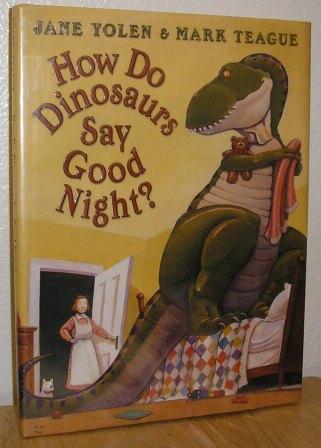
How Do Dinosaurs Say Goodnight?, one of a series of marvelous, fantastic, wonderful books starring dinosaurs, was written by Jane Yolen and illustrated by Mark Teague.

customer image from Amazon.com


1. Read Aloud
Language Arts

Read the story to your child and/or watch the storybook video.

2. Tuck in Dinosaurs
Story Interest/Pretend Play

Make a cozy box, container, or doll bed into a bed for some toy dinosaurs. Use dinosaurs you already have at home or print and cut out pictures of dinosaurs. Don't forget pillows, blankets, and teddy bears! Let your child soothe dinosaurs who are stomping, roaring, or crying. Show your child how to read a story and give hugs and kisses and tell the dinosaurs good night.

3. Dinosaur Roar!
Outdoor Activity/Dramatizing

This is a good opportunity to teach outdoor voice versus indoor voice. Tell your child dinosaurs are allowed to whisper inside the house. Practice whispering. Then say that they are allowed to roar when they are outside!

Go outside and practice roaring at the top of your lungs. Try a Velociraptor roar, then a Tyrannosaurus roar, then a Brachiosaurus roar. Do they sound different?

4. No Jumping on the Bed
Gross Motor Activity/Dramatizing

Lay a rug or mat out on the floor. Put pillows at the head. Pretend to be naughty dinosaurs jumping on the bed. Jump up and down on the mat. (If you are putting the rug or mat on a smooth floor, be sure it won't slide and cause accidents.)

When you are done being naughty dinosaurs, lay down and pretend to sleep. Older children might like to snore or learn to pretend-snore.

5. Teddy Bear Toss
Gross Motor Activity

Take a laundry or other type of basket and place it somewhere in front of a couch that your children can sit on. This game is fun with more than one person, if possible. Place a pile of teddy bears (and other stuffed animals, if you like) next to your children. Have them take turns tossing a bear into the basket. Encourage them to get the bears as close to the basket as possible, if not inside it.

Caution: If you are in the middle of teaching a baby or young toddler not to throw things in the house, you may want to adapt this activity. Place the pile of bears on the floor next to the basket and announce that it's clean-up time! The bears all want to go inside! Then take turns placing bears nicely into the basket. When you're finished, the basket can be dumped out and you can start again.

This activity is great for babies who can sit up and throw (or drop) things. It is also great for toddlers, preschoolers, and young siblings playing together.

Additional Ideas:

I just found this post on a Dinosaur Theme Week at one of my favorite blogs, Children's Learning Activities. Dig in to these ideas!

Also see my post highlighting the Dinosaur Popsicle-Stick Puzzle activity from Crafts~N~Things for Children for a great activity that is easy to do.

Tuesday, May 24, 2011

Storybook Week 7: Harold and the Purple Crayon

This week the storybook is Harold and the Purple Crayon, written and illustrated by Crockett Johnson.


1. Read the Book
Language Arts/Story Interest


Together with your child, read the book or watch the storybook video.


2. Make a Safety Town
Arts and Crafts/Safety/Dramatizing/Pretend Play

In Harold and the Purple Crayon, Harold decides he needs a moon, so he draws one. He needs a path, so he draws one to walk down. Through his adventure, he keeps hold on his purple crayon so that he can create what he needs, whether it be a shortcut across a field or a whole city. This is a powerful concept for children. The idea that they can create the world they want to play in through their imaginations is a breathtaking one.

I like this Safer Strangers, Safer Buildings video from Child's Eye Media to combine safety information for young children with a way to play pretend with these new ideas. Look at the end of Part 2 to see the safe buildings the children make to create a safe town. It looks like they are making the buildings out of small cardboard boxes about the size of instant oatmeal boxes. The boxes are covered with white paper so that the children can draw any embellishments or signs they like on their buildings. Adding people and vehicles to the town would of course make it even more fun.

3. Purple Paper Night Sky
Arts and Crafts

Your child may want to draw with a purple crayon after reading this book. That would be fantastic; let your child do what he or she likes with a purple crayon and paper. Be prepared for a nice story about what is being drawn.


A different activity for children who are not interested in a purple crayon is to use purple construction paper and white chalk to make a night sky. The texture of chalk on construction paper can be a learning experience in itself.

For a baby or toddler: Allow your baby or toddler to use chalk on construction paper if baby is old enough to safely hold and use chalk. Your toddler may be quite fascinated with making white marks on a colored paper instead of the other way around.

For a preschooler: Ask your child to draw stars and a moon on your purple paper to make a night sky. You might even add to the picture yourself.


For an older child:
Combine learning about constellations with drawing some on the paper. If you have not already learned together about constellations, look up some pictures of constellations in the sky. For this arts and crafts activity, have your child make up his or her own constellations and name them.


4. Sailboats
Story Interest/Science

Harold draws a sailboat and sails across water. How does a sailboat work? What makes it go?

Explain that a sailboat needs its sails to be up so that wind can blow the sails and push the boat.

For a toddler or preschooler: Find two plastic bath toy boats, one with a sail and one without. Draw a bath, put your child in, and do an experiment. First put in the boat without a sail. Blow on it. Allow your child to blow on it too. The breath might move it a little bit but likely won't push it forward very far. Now take that boat out and put in the boat with the sail. Blow on the sails. This boat should move forward much more easily because there is wind in its sails.

For an older child: Have your child build a sailboat. Here is a link to a 5th Grade Sail Boat Project.


5. Finding Your Room
Geography/Story Interest/Physical Activity

Start in your child's bedroom. Now lead him or her out to another room. Instruct your child to go back to the bedroom. Ask how they found it. Go to another room. Tell your child to get back to the bedroom as quickly as possible. Try this from one other room.

For a toddler: Do the above activity, emphasizing which room is your toddler's room. Have fun with it! If your toddler needs an extra challenge, try it with all the lights out and a flashlight.

For a preschooler: Do the above activity, asking your child which direction they are going as they navigate to their room. Do the flashlight variation because a preschooler will be delighted with it!

For an older child: Have your child first walk back to the room, then sit down somewhere and draw a map to show the way they walked. This map can be as simple or as elaborate as necessary. Some preschoolers can do this activity.


Note: Anytime you or your child gets excessively frustrated with an activity, take a deep breath and remember the purpose of the activity. Some of your purposes may be: To teach, to learn, to have fun, to spend quality time together, and to evaluate your child's abilities. It is usually better to avoid an outburst of frustration with each other than to complete an activity. Sometimes just taking that breath, looking each other in the eyes, and thinking for a moment about the real issue bothering one (or more) of you is extremely valuable.

Monday, May 9, 2011

Storybook Week 5: Curious George Rides a Bike

Curious George Rides a Bike was written and illustrated by H. A. Rey and published in 1952.

1. Read the Story
Language Arts

Read the story Curious George Rides a Bike and/or watch the Storybook DVD.

2. Ride a Bike
Gross Motor Skills/Outdoor Activity

If your child has a bike, go for a bike ride together. If your child is too young for a bike but has another riding toy, use that instead. If your child does not have any riding toy, show him or her how to bicycle your legs in the air while lying on your back. Do pretend pop-a-wheelies this way. See who can "jump the bike" the highest.

3. Get Your Headlines Here
Story Interest/Money

Do you get a newspaper delivered to your house? Start a conversation with your child about how that newspaper gets to your house. Or if you get a magazine subscription, talk about how that magazine gets to your house. If you don't get newspapers or magazines, go to a local store to buy one. Talk about the person who sold the paper or magazine to you.

Pick one of these jobs (newspaper delivery, mail carrier, cashier) and research it with your child. You can simply describe the job and be on the lookout for the person who has that job in your neighborhood, or you can go as deeply into the research as you like. This is a link to the Bureau of Labor Statistics page about United States Postal Service mail carriers.

This may be a good time for a money lesson. Let your child know what your family pays for (home, groceries, clothes, electricity, TV service, etc.). If possible, let your child see the bills and see you paying them. Explain where your family's money comes from. Introduce the concept of having a job and being paid for it. If your child is old enough to ask for or desire money to buy something he or she wants, consider paying a wage for a job that is more than what they are normally expected to do around the house.

4. Make a Boat
Story Interest/Arts and Crafts/Science

Mathematische Basteleien has clear instructions for folding a boat out of paper.

For a baby: Draw a bath or a bowl full of water and float toy boats in it. Let baby play if possible (supervised extremely closely, of course).

For a toddler: Let your toddler watch you fold a boat for as long as it holds the toddler's interest. You may need to fold it later if interest wanes. When the boat is completed, draw a bath for the toddler and both of you can watch while the boat floats. Very soon, it will sink (due to getting wet) and need to be rescued. Have plastic bath boats on hand to replace it.

You may want to do the baby activity instead if that is a better fit for your toddler. Or do both!

For a preschooler: Both of you work on folding a paper boat at the same time. Don't forget to see if they float when you're finished.

For an older child: Show the instructions and demonstrate once by folding a paper boat. Then let your child try as many times as he or she wishes.

5. Make a Circus
Story Interest/Dramatizing

Depending on the age and interests of your child, do this activity either with small figures and doll-type decorations or in real-life size with stuffed animals, larger props, and yourselves as actors.

Small or large items (depending on your scale) that would make a fun circus:

Animals
Tents (toy tents, draped blankets, real tents, or dolls' or figures' umbrellas)
Musical instruments
Music playing in the background
Circus ringmaster and microphone (Here are some ideas for making a ringmaster costume, by Andrea Hermitt.)
Rope, yarn, or string (laid on the ground for a pretend tightrope)
Dancer or acrobat costume (think tights, leotards, and makeup)
Yoga mat for doing somersaults and other acrobatics
Mini trampoline
For dolls or figures, a colorful circular blanket or mat on which to arrange the circus
Clown costume or clown dolls
Popcorn, cotton candy, peanuts (for children who are old enough to safely eat these treats)
Bicycles, chariots, carts
Capes, crowns, scepters, wands
Magic implements, top hat

Now have fun!

Tuesday, April 12, 2011

Storybook Week 2: Chicka Chicka Boom Boom

Chicka Chicka Boom Boom was written by Bill Martin, Jr., and John Archambault and was illustrated by Lois Ehlert. This is another classic children's book, one that many people call the best storybook for children under six. It should be readily available at the library, on Amazon.com or Barnesandnoble.com, or in brick and mortar book shops. We have the DVD as part of the Scholastic Treasury of 100 Storybook Classics. (I do not get any benefit from recommending these sites, books, or DVDs - they are simply things that I have used and liked.)

1. Coconut Tree Craft
Arts and Crafts/Story Interest


Read the book or watch the DVD together. Use this simple Coconut Tree Craft from DLTK's Growing Together website.

Adjust for toddlers and younger preschoolers by cutting and/or pasting for them.


For older children or those who have an interest, look up coconut tree facts and pictures to learn more. Show them on the map where coconut trees mostly grow. Here at 4to40.com are some facts about coconuts.


2.  Letters Come Tumbling Down
Story Interest

For this activity, you will need a foam, magnet, or other set of letters of the alphabet. Use the coconut tree craft you made in Activity 1. With your child, play out the story with these letters. Have A ask B to go up the tree. March or skip the letters up the tree and set them in the branches or leaves or on the top of the tree. When they have all gotten up the tree, make them tumble down!

For a toddler: 

Make a big deal of the tumbling down part. Shake the paper tree until the letters fall down. Pick up the letters again and repeat the activity. This will be even more fun for a toddler if you get a box or container and tape or glue the picture of the tree inside the container. It will become another way for toddlers to play the clean-up-dump-out-clean-up-dump-out game. (I know my toddler loves this game!)

3. Be a Letter
Dramatizing/Sensory Activity

Use your own and your child's bodies to form letters of the alphabet on the floor. Your child may like to stand up and form the shape of a letter as best she can on her own in order to act out part of the story. It would be even better to have someone on hand to take pictures of this activity.

For a toddler:

Try forming the letter A by standing with legs apart and arms overhead with palms together. Say, "A! I'm the letter A!" See if your toddler can imitate you. Take pictures!

4.  Who Wrote the Book?
Language Arts

For this activity, you will need the book physically on hand. You may also want to have other books written by Bill Martin, Jr., or illustrated by Lois Ehlert to look at. There are many books by these two at the library.

For a preschooler or kindergartner: Open to the title page and tell your child that this is called the title page, and that every book has one. Show them what information is on the title page.

Tell them that the person who wrote the words in the book is the author. Give them the author's name. If you have other Bill Martin, Jr., books, show those to your child and point out his name on each of the title pages.

Explain how the person who drew (or created) the pictures in the book is called the illustrator. If you have other Lois Ehlert books on hand, show them to your child and point out her name on the title pages.

Ask, "Who is the author of this book?", pointing to Chicka Chicka Boom Boom.

Ask, "Who illustrated this book?"

For a toddler or baby: Read and show books by Bill Martin, Jr., or illustrated by Lois Ehlert. Continue as long as it holds your baby's or toddler's interest. Keep the books near to look at them and read from them throughout the next week or two.

5. Cook a Coconut
Cooking/Sensory Activity

CDKitchen has an Easiest Coconut Pie recipe that children can help with. Older children can help with all of the recipe; younger children can pour or toss in the shredded coconut. The Homemade Baby Food website says that coconuts are not a common allergenic food and has more information on babies and coconut. According to that site, coconuts are not related to peanut or tree nut allergies but are related to latex allergies. Please use your pediatrician's guidance to determine what your baby can safely eat.

If you can find one and have the money in your grocery budget, it would be very helpful to buy a real coconut so your child can handle it, look inside (once an adult cuts it for them), and compare the shredded coconut to the whole coconut. Chowhound has some readers' ideas for using a whole coconut.
Related Posts Plugin for WordPress, Blogger...