Monday, June 13, 2011

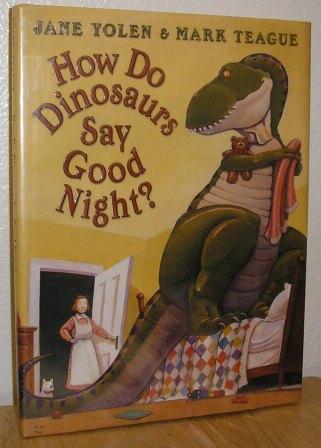
Storybook Week 8: How Do Dinosaurs Say Goodnight?

How Do Dinosaurs Say Goodnight?, one of a series of marvelous, fantastic, wonderful books starring dinosaurs, was written by Jane Yolen and illustrated by Mark Teague.

customer image from Amazon.com


1. Read Aloud
Language Arts

Read the story to your child and/or watch the storybook video.

2. Tuck in Dinosaurs
Story Interest/Pretend Play

Make a cozy box, container, or doll bed into a bed for some toy dinosaurs. Use dinosaurs you already have at home or print and cut out pictures of dinosaurs. Don't forget pillows, blankets, and teddy bears! Let your child soothe dinosaurs who are stomping, roaring, or crying. Show your child how to read a story and give hugs and kisses and tell the dinosaurs good night.

3. Dinosaur Roar!
Outdoor Activity/Dramatizing

This is a good opportunity to teach outdoor voice versus indoor voice. Tell your child dinosaurs are allowed to whisper inside the house. Practice whispering. Then say that they are allowed to roar when they are outside!

Go outside and practice roaring at the top of your lungs. Try a Velociraptor roar, then a Tyrannosaurus roar, then a Brachiosaurus roar. Do they sound different?

4. No Jumping on the Bed
Gross Motor Activity/Dramatizing

Lay a rug or mat out on the floor. Put pillows at the head. Pretend to be naughty dinosaurs jumping on the bed. Jump up and down on the mat. (If you are putting the rug or mat on a smooth floor, be sure it won't slide and cause accidents.)

When you are done being naughty dinosaurs, lay down and pretend to sleep. Older children might like to snore or learn to pretend-snore.

5. Teddy Bear Toss
Gross Motor Activity

Take a laundry or other type of basket and place it somewhere in front of a couch that your children can sit on. This game is fun with more than one person, if possible. Place a pile of teddy bears (and other stuffed animals, if you like) next to your children. Have them take turns tossing a bear into the basket. Encourage them to get the bears as close to the basket as possible, if not inside it.

Caution: If you are in the middle of teaching a baby or young toddler not to throw things in the house, you may want to adapt this activity. Place the pile of bears on the floor next to the basket and announce that it's clean-up time! The bears all want to go inside! Then take turns placing bears nicely into the basket. When you're finished, the basket can be dumped out and you can start again.

This activity is great for babies who can sit up and throw (or drop) things. It is also great for toddlers, preschoolers, and young siblings playing together.

Additional Ideas:

I just found this post on a Dinosaur Theme Week at one of my favorite blogs, Children's Learning Activities. Dig in to these ideas!

Also see my post highlighting the Dinosaur Popsicle-Stick Puzzle activity from Crafts~N~Things for Children for a great activity that is easy to do.

Thursday, June 9, 2011

Guest Post at The Steady Hand: The Toddler Dress-Up Game

I don't think there can ever be enough easy, quick activities in the repertoire of toddler parents, do you? Invention, quick wits, patience, and childlikeness are all great tools for the toddler-parent toolbox. And snacks. And soft, bouncy walls and floors.

The Steady Hand has posted my Toddler Dress-Up Game today, so if you have a curious, busy toddler take a look!

Booking Through Thursday: Own or Borrow?

Booking Through Thursday hosts a weekly meme with a bookish question each Thursday.

This week's question is: "All things being equal (money, space, etc), would you rather own copies of the books you read? Or borrow them?"

Both! I do not need a copy of every book I read and probably would not return to most of them if I did own a copy. Yet I am one of those people who re-reads beloved books dozens of times.

I recently confessed to my husband that if anything happened to my copies of The Lord of the Rings trilogy (and The Hobbit) and The Chronicles of Narnia, I would feel lost and partly empty until I replaced them.

Since this blog is about children and learning activities, I'll address the question from the standpoint of children's books. For the most part, I would prefer to own many children's books. That way, the children can see them in the bookcase and pull out whatever book they would like to explore. On the other hand, we have access to thousands of books and dozens of magazines at the public library. I would never buy all of those books or magazines, no matter how much money I had. Taking advantage of our public library means a nearly infinite stash of reading materials to choose from!

Wednesday, June 8, 2011

Daily Focus for a Five-Year-Old


A week ago, I posted about a process I go through each morning to help organize my tasks and my brain. I mentioned that I would be trying it with my older son for a week and reporting back.

Here is the report.

I went through the process the same way with my son that I do with myself, with one exception. I only asked him for one to two tasks in each of his categories to keep it age-appropriate.

To quickly recap, the process includes three steps: 1) writing Daily Focus on a piece of paper and listing one to three things to focus on accomplishing that day, 2) writing Daily Order underneath that and listing prioritized tasks according to prioritized life roles (like student, son, brother, worker, etc.), and 3) writing Extraordinary Thing underneath that and listing one extraordinary, amazing, over-the-top, or brave thing you will do today.

These are some examples of things my son listed under Daily Focus: playing, play-fighting, eating dinner. It turned out that he prioritized his life roles this way: Number 1 was player, number 2 was worker, number 3 was brother, and number 4 was son. I usually had to prompt him about his required chores under the worker category. His other tasks were things like giving hugs, play-fighting with his brother, and being nice. When he starts school in the fall, he will have a few more important tasks to think about in terms of getting ready for the next day and possibly homework.

When I asked what he thought about this process, he said, "Nothing!" There are parts of this exercise that are not very useful for a five-year-old or younger, but I still think getting into an organizing and planning habit is worthwhile even at this age.

One of the most useful parts of the process with him was the Extraordinary Thing. He is at an age when it is important to him to be admired for his skills. One day his Extraordinary Thing was a spin-jump, and he wanted me to watch while he did about eight spin-jumps, trying to perfect them into one perfectly amazing spin-jump. It was good for him to have that outlet.

I think it is good for people of all ages to have that outlet. Even if doing an Extraordinary Thing does not earn you anyone else's admiration, it may earn you your own approval, which always feels good.

Monday, June 6, 2011

Summer Reading Programs

In our area, there are several summer reading programs for children to earn small prizes by reading books (or having books read to them). My oldest is only five years old, so he is not eligible for Pizza Hut's Book-It! program yet, but that is always a fun one, too. My younger son is only two years old, but almost all of the programs I have seen welcome children this age who are having books read to them.

The two main things to consider when enrolling are:

1.) Will this program be fun for my child? (Or, will it kick-start some reading interest in my child if my child has none right now.) My children like books, so I want to be careful not to turn reading into a big chore for them.

2.) What are the prizes? If the prize is a shirt that only comes in large sizes, there is not much reason to sign up your toddler. If it is a bookstore voucher, you could easily use the prize on any age child.

Look for reading programs at local bookstores and grocery stores as well as your library. This morning our local library kicked off a summer reading program...and Clifford the Big Red Dog and Curious George showed up! There was a coloring page to go with the theme that both boys finished:


We are now signed up for three reading programs, which is more than enough to keep track of. It can be a good idea to sign up for more than one if you and your children will finish one of them early. For example, one of our reading programs asks for ten books that your child has read over the summer. We are still reading lots of picture books along with some chapter books, so this program will be very quickly completed.

Thursday, June 2, 2011

"Yes!" Day

The idea of "Yes!" Day came from another blogger or blog commenter whom I cannot find again. I think the idea was posted on Inspired to Action or Wonder Woman Wannabe; both of those article links are fantastic reads for parents needing a bit of inspiration around having fun with their children.

Every child-parent relationship needs a "Yes!" Day at least once a year. On "Yes!" Day, the parents say "Yes!" to all of their children's requests (with some exceptions).

I command...ice cream cones!


Implementation is simple, and there are only three preparatory steps. And one of the steps is optional!

Prep. Step 1:

Brace yourself to say yes to children's requests that you would normally and automatically say no to. While you are bracing yourself, make a list of things that you will not be able to say yes to due to safety hazards or monetary constraints. Think of a fun way to say no to those things, like, "Yes when you are sixteen years old!" or "My mouth cannot say yes because I love to see you alive and unharmed!" Make it a silly "no" if you think that will be appropriate for your child. If you think your child will manipulate "Yes!" Day and spend all day asking for things to see just how much he or she can get, you may want to write and post a list of things that the child may ask for on this special day, and check them off as the child asks for them.

Prep. Step 2: 

Tell your child the day before that you are celebrating "Yes!" Day tomorrow. That means whatever the child requests to do or have, within reasonable limits, will be granted. Share with your child the list of things you cannot say yes to and explain the reason. Younger children will need more preparation with lots of examples of things you will say yes to (that you normally say no to) and lots of examples of things that you will not be able to do.

Prep. Step 3 (optional):

You may or may not want to stock some supplies for "Yes!" Day, like ice cream and cones or new bubbles or a dirt or water toy or a movie rental. Or you can just wait until the child asks for something on the day, and then go get it. The latter strategy could be helpful in limiting the number of requests if you fulfill them one at a time. On the other hand, it might use up extra gas for the car and give your child innumerable new ideas at the shops!

Hint 1: Take pictures of "Yes!" Day and then display them around the house.

Hint 2: A "Yes!" Day is beneficial in proportion to how different it is from daily life. By this I mean that most of children's days should be limited by reasonable, age-appropriate, and parent-set boundaries to keep them safe, secure, and learning about the world. A "Yes!" Day can then be a parent's way of acknowledging that pure and simple fun is a good thing, too.

Wednesday, June 1, 2011

An Idea for ADHD Symptoms

I will start by saying I have not been diagnosed with ADD, but it runs in my immediate family. Whether or not you believe in the existence of ADD as a true disorder, you may notice that certain types of food, organization, and activities help some of your more active or unfocused children.

Organization is key for me. If I don't organize my activities, my brain feels fuzzy and it's a struggle to accomplish anything.

                                                                               Image courtesy of clker.com

I have found it helpful to list certain things at the start of the day. This is the third thing I do each morning, after getting dressed and ready and doing devotions. It is extremely helpful for me as an adult; I can see how it would be very helpful for a teenager or college student; and I think it would be an excellent practice to start with younger children so that they get into the habit. In fact, I will start tomorrow by helping my five-year-old do this for six days, and then I will report back on the experience.

Materials:

There is blank notebook paper near the beginning of my homemaking binder. There is also a pencil in a pencil holder in the binder. This is very important! The first time you get up from the task of writing down the daily list might be the time that you get distracted and don't come back to it.

Procedure:

I write "Daily Focus" at the top of the page. For each day of the week, I have selected one to three areas to focus on that day. For example, today was 1) planning guest posts for another blog and 2) errands (which I listed).

Next, I write "Daily Order." Underneath that heading, I number the tasks I want to get done that day.

I have previously made categories of my roles and prioritized them (for example, 1) wife; 2) mother; 3) homemaker; 4) moneysaver; 5) volunteer). So my Daily Order starts with a subheading of Wife, then #1: (whatever task I most want to get done that day that pertains to being a wife). Continue to number tasks as long as you can think of tasks you want to get done that day in that category. Then write the next subheading and continue to number tasks below that category. Continue with other categories, in order of priority.

I have a rule for myself: If I've almost reached the end of the page, I have to stop. It's unlikely I will get through a whole page of tasks in one day, so I have to accept that and stop somewhere.

Last, I write the heading "Extraordinary Thing for Today."This is the place to write down one special, above-and-beyond, excellent, or brave thing you will do today.

Usage:

I refer back to this page during the day, especially each time that I start to get distracted and wonder what I was going to do or should do next. This often happens to me!

The list does not help me accomplish each and every task I can think up, but it does help me have a clear conscience or sense of purpose as I go through my day, and that's worth a lot.
Related Posts Plugin for WordPress, Blogger...