Friday, July 22, 2011

Simple Water Table Coloring


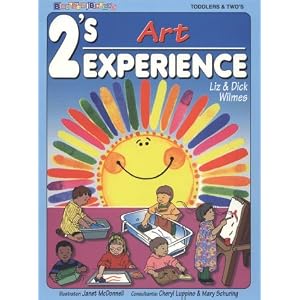
A simple spring or summer activity: Transform the water/sand table into an art canvas. This is another activity adapted from the book 2's Experience Art by Liz and Dick Wilmes. A roll of paper is placed over the table and taped to the sides. I simply put the paintbrush markers in one of the smaller water compartments of the table, right underneath the paper but visible and reachable. The purpose of this activity is to liven up coloring time for little ones and show them the fun of experimenting with art venues and materials. In the book, this is meant to be a crayon coloring activity, but in our area I don't think crayons would last more than five or ten minutes outside before melting down.


The book looks very unsophisticated and, in fact, it is. It does not give academic explanations for the different activities. Many of the activities are simple. However, I love this book. It is perfect for two-year-olds, just at their level, yet keeping them learning.

I really like the beginning pages that show some different ideas for displaying children's art. With inspiration from this book, my husband hung a stuffed animal hammock in the upper corner of our toddler's room to which we safety-pin his art projects. I believe displaying children's works has a great impact on them and gives them motivation to keep learning and mastering activities.
Photobucket

Wednesday, July 20, 2011

Two Ways to Help Children Learn Faster


Some people may be a bit disgusted with Way #1 to help children learn faster. It has taken many experiential lessons for me to accept Way #1, but I have finally realized its worth.

Way #1 to Help Children Learn Faster:

Give them more time.

Most skills that we want our children to learn will be learned in time. Extra struggles come when we try to make them learn things sooner than they are ready to learn them.

Parents are not helped by state and school standards here, or guidelines and rules of thumb from experts and non-expert advice givers. When we see an age next to a skill, we want our child to have learned the skill AT LEAST six months earlier than that age. Right? Am I the only one?

Those standards and guidelines are made for a reason, and they are helpful in certain circumstances. For most children, they should be used only as a guide and not as an age past which your child will never acquire the skill and the world will come to an end.

I recently read a very interesting book called The Way of Boys: Raising Healthy Boys in a Challenging and Complex World. The author, Anthony Rao, Ph.D., seems to recommend two basic strategies to help boys acquire social skills: One is to simply wait for them to grow up a little! Most boys will mature in a healthy way and acquire the skills they need. The problem arises when they don't do it fast enough for their parents or teachers or school administrations.

His second strategy is to use consistent behavioral programs (such as clear rule-setting, slow progression from simple to more complicated behaviors, and rewards like sticker charts).

I'm sure many of us can share stories of working day after day, painstakingly, with a child to gain a particular skill and getting nowhere with it. Then some time later, the same child can "suddenly" do it with almost no effort at all. Laying groundwork by working on particular skills is well and good, and very helpful, as long as it done as slowly as necessary and without high emotional stakes placed on learning something right away.

Way #2: Embrace Your Child's Interests

Here is an illustration: I wanted to teach my older son chivalrous manners, though I wasn't sure how to go about it. It finally hit me that he would be amenable to talking about chivalry and manners through King Arthur's knights of the Round Table. He has an obsession with knights, castles, kings, battles, and good and evil. I began to talk about chivalry and what it meant to King Arthur. 

He said, "Watch this, Mom!" and went down into a low bended-knee bow. It was a perfect example of a knight's bow, complete with hands gripping the hilt of an imaginary sword.

Due to his passion for all things knights-related, he had already absorbed at least that much of a medieval sense of chivalry and honor. This was an easy topic to discuss.
 
Sometimes a favorite stuffed animal role-playing what we want to teach is more effective than words coming out of Mommy's mouth. Sometimes Daddy or an aunt or uncle is a better teacher because our child is able to listen more intently to them at that time.

People have always known it is easier to encourage children to do things if they are related to the children's interests. Diego toddler utensils, Dora toothbrushes, dinosaur stickers on a potty training chart...  We probably all use this method quite often. 

There are some things that family members here are slowly learning to do. I coach myself to take a deep breath and remember that, contrary to what my brain is telling me, there is not a specific date on the calendar that these things have to be perfectly learned. It also helps to look around for examples of things that I myself have taken long taken a long time to learn. And I successfully made it through all my (academic) schooling!

Thursday, July 14, 2011

Learning a Phone Number

Image courtesy of www.clker.com


We are now at the point that I want my son to know my cell phone number, for safety reasons. He needs to memorize ten digits, but that won't be a problem. Young children's minds are like steel traps!

Here is what is working for us.

I wrote the first three digits on one piece of paper (a long notepad page, like what you might use to jot down a grocery list) and put a sticker of The Thing next to them.

The next three digits went on another piece of the same type of paper. A sticker of Diego and Baby Jaguar went next to them.

The last four digits - same thing. Spiderman is crouching next to them.

Over a few days, I coached my son on the first three digits.

"What is the first set of numbers in my phone number? The Thing says, '___.'"

Very quickly, my son could say the first three numbers in his version of The Thing's voice. So I added the next set.

"What are the first numbers in my phone number? The Thing says, '___,' [pause for my son to say them] and Diego and Baby Jaguar say, '___.'"

Sooner than I thought it would happen, he could recite the first six digits. Today at the pool, he made a new friend and asked him over to our house sometime. He told the boy the first three digits of my phone number so he could call us. Hmm, I guess I have to add in a little lesson about needing all ten digits of a phone number, and also whom it's okay to give the number to!

Today I introduced all ten digits in the same manner. I have no doubt he will soon know the full number. We are working on our address in the same way as well.

Monday, July 11, 2011

Storybook Week 10: Make Way for Ducklings


Make Way for Ducklings was written and illustrated by Robert McCloskey. This is one of the classics that is a delight to hold in your hands while looking at the wonderful illustrations.

1. Read the Story
Language Arts
 
Read the book Make Way for Ducklings, or watch the storybook video, or both. Take your time and enjoy this classic book.

Although, in my opinion, there is nothing that can replace a book, the storybook videos in Scholastic's Treasury of 100 Storybook Classics are well-done. What I like about them are the slow pace, the animation in the style of the original illustrations, and the use of the original text of the books. Each of these videos is more like the experience of a read-aloud than any video other I have seen.

2. Nesting
Story Interest/Dramatizing/Science

With your child, explore the house for just the right spot to make a nest. When your child has found the exact right spot, mark it with a pillow or anything else that comes to hand.

Now, together you must collect the materials for your nest. Younger children will need your suggestions of using pillows, blankets, etc., for next materials. Older children will most likely have plenty of their own ideas.

Make the nest, and sit on it, of course. If your child wants eggs to sit on and to hatch, crumpled and shaped paper works well. If you have miniature bird figures at home, they can even be inserted into the middle of an egg.

Optional: After doing the activity, watch a video of birds making a nest. Discuss the things you did to make your nest that were similar and different.

3. A Second Breakfast of Peanuts
Story Interest/Fine Motor Skills

All who are not allergic to nuts and who are old enough to eat them can have a "second breakfast" just like the Mallards'. Raisins could also be used instead of nuts.

Get out a jar of peanuts and pour them into a container with a wider opening. Give your child a  bowl for his or her peanuts, and a pair of tongs or tweezers. With the tongs or tweezers, your child should practice transferring peanuts to the snack bowl. Depending on the utensils and the child, this might be a challenging activity. A small measuring cup or spoon can be substituted for the tongs or tweezers.

4. Make Way for Ducklings Interactive Map Activity
Social Studies/Geography

Use this amazing interactive map to take the journey the Mallards did!

5. Police Officers to the Rescue
Social Studies/Dramatizing

Using rubber duckies and a road made of blocks, car tracks, or a road drawn on a piece of paper, have your ducks try to cross the road. A line of Matchbox cars or other vehicles waiting to the side heightens the sense of danger.

Have your child, the police officer, stop all traffic with a commanding hand so the ducks can safely cross. This police hat and badge printable would help your junior officer(s) a lot!

Sunday, July 10, 2011

DIY Chef-In-Training Custom Cookbook


Okay, when I post Do-It-Yourself projects of my own making, you can bet that they will be super-simple and super-quick. Otherwise, I would probably fail at them.

I also dislike spending a lot of money on a craft (except knitting! I will spend more on knitting projects), so the materials must be easy and inexpensive to acquire.

This project was inspired by my creative son and took almost no extra work to put together.

Background: My five-year-old keeps coming up with ideas for creative foods to make and asking that we cook them. They are creative enough that most of the time we wouldn't be able to make them right then and there. I finally decided I wanted to encourage this creative cooking streak, so I did the following:

Image courtesy of clker.com


1.) Bought a spiral-bound index card notebook. (Like this*, although ours is 3" x 5.)

2.) Told my son the plan and got his go-ahead.

3.) Decorated/labeled the book. My son wasn't into decorating it at the time, otherwise we could have really gone to town on it.

4.) Wrote headings on separate index cards for his recent suggestions that I remembered.

5.) Planned a time to make the recipes, one by one, over time.

These are the names of a few of his recipes: Fruit Salad Pizza, Doughnuts (decorated just like Arnie - see this book*), Yogurt with Sprinkles, Chocolate Sauce Bananas.

I think this would be one of my best ideas yet, if it were my idea. Thanks, son!


Photobucket 

*Afterschool Homeschool is now a participant in the Amazon Services LLC Associates Program, an affiliate advertising program designed to provide a means for sites to earn advertising fees by advertising and linking to amazon.com. Where I have noted that I do not receive compensation for reviewing or linking to an item, that is true and means that the relevant link is not an affiliate link. 

Friday, July 8, 2011

Winter Fun In the Summertime: Movie Marathon

Image courtesy of clker.com


At the beginning of summer, I posted an idea to have winter fun in the summertime when it gets dangerously hot out there. Yesterday we put into action #5: the (Indoor) Movie Marathon.

After swim lessons in the morning and a sweltering trip to Target, I decided I wouldn't put the children out to play in this heat.

We have young children, so rather than choose a theme of favorite summer or winter movies, I allowed each one to choose a movie. I closed all the blinds, put popcorn in the microwave, and set them on the couch with the first-choice movie. Whew! An air-conditioned house feels really fabulous after a car ride.

If you start to feel guilty about plopping the youngsters in front of the TV, go all out with the theme of the movie and put fun themed props on the coffee table in front of them. My children spend just as much time playing pretend as watching the movie. Oh, and they also spend a lot of time on serious popcorn-munching.

Caution: The American Academy of Pediatrics lists popcorn as one of the foods that poses a high risk of choking among children.


Image courtesy of clker.com

It's not that my little ones aren't watching TV anyway at certain times of the day, but I always feel better when our mindless activities are scheduled in. Do you?

Thursday, July 7, 2011

How Do Dinosaurs...? Puzzle Activity

For anyone doing the How Do Dinosaurs Say Goodnight? Storybook Week (or anyone whose children love dinosaurs), this activity from Crafts~N~Things for Children is a spectacular, easy addition. I love it!

Because my children love both dinosaurs and puzzles, and because I have all the necessary materials (hurray!), we will be doing this activity posthaste.


Find the full How Do Dinosaurs Say Goodnight? Storybook Week here, at the link above, or in the Storybook Weeks sidebar.
Related Posts Plugin for WordPress, Blogger...